Pre-surgery anxiety is one of the most common things we see in patients preparing for LASIK at Tersigni Vision. Eye surgery — even a procedure as advanced and well-established as ours — asks something significant of you: you remain conscious, you’re trusting someone with your sense of sight, and you’re making a voluntary decision to be in a position of vulnerability. Dr. Tersigni has undergone vision correction surgery himself, so he understands what it feels like to be in that chair. If your mind has been running worst-case scenarios since you booked your procedure, this toolkit is for you. Each technique below is grounded in psychological research and designed to interrupt the fear response before surgery day arrives.
Why Your Brain Catastrophizes Before LASIK (And Why It’s Not a Character Flaw)
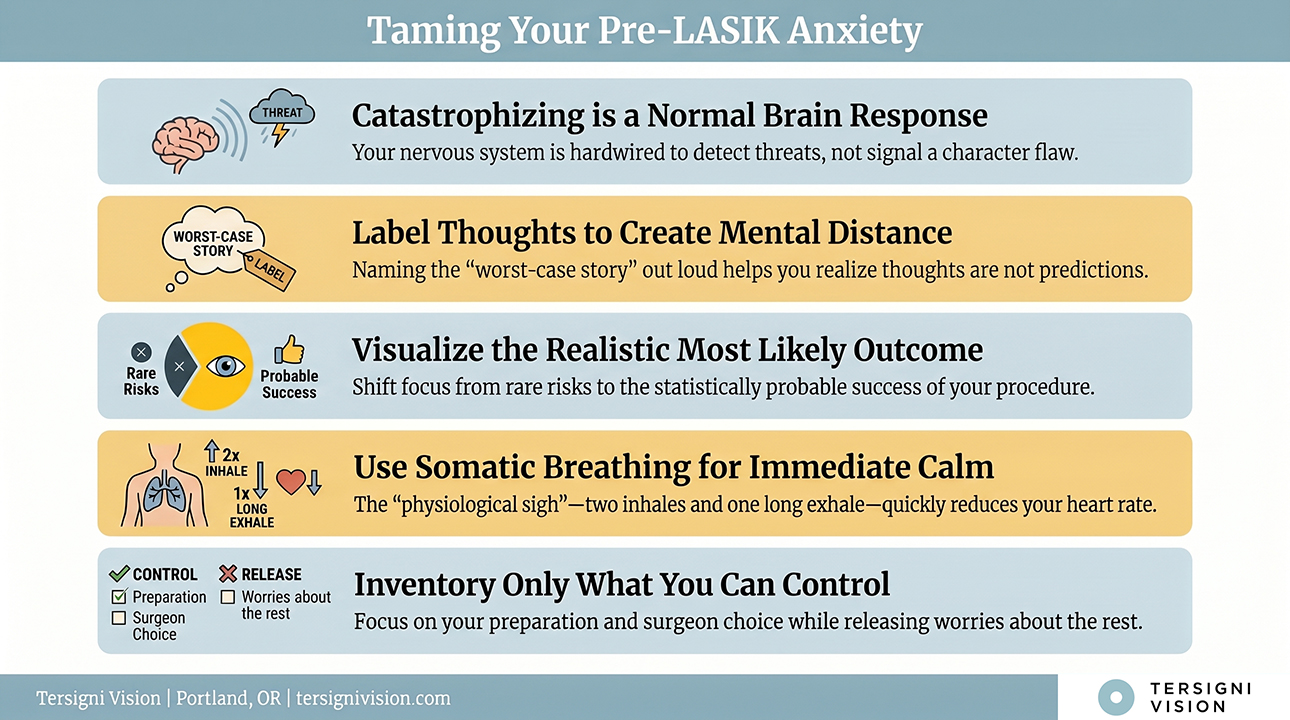
Your brain is built to detect threats. Research in cognitive psychology shows that catastrophizing — defaulting to worst-case scenarios under stress — is one of the most common responses to anticipated surgery, especially when the outcome feels uncertain. It is not a sign of weakness. It’s your nervous system doing exactly what evolution designed it to do.
LASIK has a specific set of features that activate this response more than most procedures: you are awake, a laser is involved, and the organ being treated is your eye. These are unique psychological triggers. Understanding the mechanism doesn’t eliminate fear, but it does shift the experience from “something is wrong with me” to “my brain is responding normally to an unfamiliar situation.”
The Catastrophizing Spiral: What It Actually Looks Like
Catastrophizing follows a predictable pattern. One unanswered question feeds the next, and each iteration becomes more extreme. You search for information about eye pressure during LASIK, land on a forum post from 2012, and suddenly you’re certain you are the one individual for whom everything will go wrong. The spiral moves faster when you’re tired and slower when you have concrete information. The goal of recognizing it isn’t to dwell on it — it’s to interrupt it. If you can identify the signs and symptoms of your own anxiety loop — the compulsive searching, the “what if” chains, the sense that your fear is uniquely justified — you are already positioned to do something about it.
Technique 1: Cognitive Defusion — Separating Yourself from the Worst-Case Story
Cognitive defusion is a tool from Acceptance and Commitment Therapy. The core principle is straightforward: thoughts are mental events, not predictions. When anxiety produces a catastrophic scenario, that thought is not evidence of what will happen — it’s the mind generating noise under stress.
Two practical exercises to try in the days before surgery:
- Label the story out loud or in writing. “There’s the ‘something will go wrong with my eye’ story again.” Naming it creates distance from it.
- Prefix the thought. Instead of “I’ll feel pain,” say: “I’m having the thought that I’ll feel pain.” This small addition creates a gap between you and the thought. You’re not suppressing the anxiety — you’re changing your relationship to it, which is what actually produces relaxation.
Technique 2: The “Realistic Best Case” Reframe
Patients who catastrophize tend to skip from neutral directly to worst-case, bypassing the most statistically likely outcome entirely. Research into a cognitive pattern called probability neglect shows that our minds treat a very small risk as though it’s far more probable than it actually is — which is why reading one negative result online can feel more real than the thousands of successful outcomes surrounding it.
Here’s a practical experiment: write a detailed, minute-by-minute account of your realistic LASIK experience. Not the perfect version — the likely one. You arrive at Tersigni Vision. A staff member walks you through pre-procedure preparation, including the numbing eye drops applied before any contact with your eye. Dr. Tersigni explains what you will sense during the procedure. The laser treatment takes less than a minute per eye. You go home, rest, and by the next morning your visual perception is already sharper than it ever was through glasses. Write this down and re-read it the morning of your surgery. It competes with the catastrophic version — and it’s more accurate.
Technique 3: Body-Based Calm — Somatic Strategies for the Days and Hours Before Surgery
Anxiety doesn’t live only in the mind. It shows up in the body — in shallow breathing, a racing heart, tight muscles, and nervous energy that won’t settle. Addressing the physical signs and symptoms of stress before eye surgery is as important as any mental technique.
These approaches work quickly and don’t require a long history of meditation practice:
Conscious breathing — the physiological sigh. Take two inhales through the nose (the second stacked on top of the first), followed by a long exhale through the mouth. This specific breathing pattern is backed by research on the nervous system and produces a measurable reduction in heart rate. Use it in the waiting room or in the procedure chair before Dr. Tersigni begins.
Progressive muscle relaxation. Starting from your feet, contract each muscle group for five seconds, then release. Work upward through your body. This is one of the most studied techniques for pre-surgical stress and takes roughly ten minutes. It is also discreet enough to do without drawing attention in a waiting room.
Cold water on your wrists or face. This activates the body’s vagus nerve response and slows heart rate quickly. It takes seconds.
A simple day-of protocol: conscious breathing in the car on the way to Tersigni Vision, the progressive muscle relaxation exercise in the waiting room, and controlled breathing in the procedure chair. By the time surgery begins, your body will be in a measurably calmer state. Healing after LASIK begins within hours of the procedure, and going in with lower physical tension supports that process.
Technique 4: The Pre-Surgery Control Inventory
A significant driver of pre-LASIK anxiety is perceived loss of control. The surgeon’s decisions, the accuracy and precision of the laser, the healing timeline — none of these are things a patient manages directly. When fear is high, that reality can feel paralyzing.
Make two columns. On the left: everything about your LASIK experience you can control. On the right: everything you need to release.
The left column might include: choosing your surgeon and asking every question you have until you feel informed, arranging a comfortable recovery space at home, having a support person drive you to Tersigni Vision, requesting anti-anxiety medication if Dr. Tersigni determines it’s appropriate for you as an individual, and understanding what technology will be used in your procedure.
The right column might include: the precise second-by-second sensations during surgery, the exact result on day one, and other patients’ experiences you’ve read online. The rule: take concrete action on everything in the left column before surgery day. Each completed action reduces stress tangibly. You cannot control the laser — but you can control the quality of the surgeon you have chosen and how prepared and rested you are when you walk through the door.
When Anxiety Is a Signal vs. When It’s Just Noise
Not all pre-surgery anxiety is catastrophizing. Some of it carries useful information. The question to ask yourself is: “Is there a specific, actionable concern I haven’t addressed — or is this a looping feeling with no new information?”
If there is a real, unresolved question about your individual candidacy, your procedure, or your recovery, bring it directly to Dr. Tersigni. At Tersigni Vision, we don’t use high-pressure tactics, and we encourage every patient to ask questions until they feel genuinely clear. If your anxiety points to something concrete, address it. If it does not — if it’s the same loop running again with no new facts — that is the noise the techniques above are designed to quiet.
Choosing to move forward is a decision that takes clarity and resolve. So is choosing to wait. Either way, we’re here to help you make that call with confidence.
Ready to take the next step?
If you’ve been putting off LASIK because of fear, save this article for the morning of your procedure — and share it with someone who needs it too. If you have unresolved questions about your surgery, we encourage you to schedule a consultation with Dr. Tersigni at Tersigni Vision. We’ll answer every question until you feel confident moving forward.
Call us at (971) 362-2020 or visit tersignivision.com to schedule your consultation.
Medically Reviewed By:
Steven Tersigini, MD
Board-Certified Ophthalmologist
Fellowship-Trained Refractive Surgeon, WCRS
Last reviewed June 26, 2026
source https://www.tersignivision.com/lasik/how-to-stop-your-brain-from-catastrophizing-before-lasik-a-psychologists-pre-surgery-anxiety-toolkit/


No comments:
Post a Comment